

File size: 5,697 Bytes
2f12dd0 5b7a9a4 3a47918 5b7a9a4 3a47918 5b7a9a4 6774e49 5b7a9a4 6774e49 3a47918 5b7a9a4 6774e49 3a47918 2f12dd0 1763c0a 6774e49 335998b 6774e49 d6b2804 6774e49 d6b2804 6774e49 d6b2804 6774e49 d6b2804 6774e49 d6b2804 6774e49 d6b2804 6774e49 d6b2804 6774e49 d6b2804 6774e49 d6b2804 6774e49 d6b2804 6774e49 d6b2804 6774e49 d6b2804 6774e49 d6b2804 6774e49 d6b2804 7f3968b 4449e9d 7f3968b 7f23d5c d6b2804 2f12dd0 b71b4ad 2f12dd0 6774e49 2f12dd0 6774e49 3a47918 |
1 2 3 4 5 6 7 8 9 10 11 12 13 14 15 16 17 18 19 20 21 22 23 24 25 26 27 28 29 30 31 32 33 34 35 36 37 38 39 40 41 42 43 44 45 46 47 48 49 50 51 52 53 54 55 56 57 58 59 60 61 62 63 64 65 66 67 68 69 70 71 72 73 74 75 76 77 78 79 80 81 82 83 84 85 86 87 88 89 90 91 92 93 94 95 96 97 98 99 100 101 102 103 104 105 106 107 108 109 110 111 112 113 114 115 116 117 118 119 120 121 122 123 124 125 126 127 128 129 130 131 132 133 |
---
license: bigscience-openrail-m
widget:
- text: >-
Native API functions such as <mask> may be directly invoked via system calls
(syscalls). However, these features are also commonly exposed to user-mode
applications through interfaces and libraries.
example_title: Native API functions
- text: >-
One way to explicitly assign the PPID of a new process is through the <mask>
API call, which includes a parameter for defining the PPID.
example_title: Assigning the PPID of a new process
- text: >-
Enable Safe DLL Search Mode to ensure that system DLLs in more restricted
directories (e.g., %<mask>%) are prioritized over DLLs in less secure
locations such as a user’s home directory.
example_title: Enable Safe DLL Search Mode
- text: >-
GuLoader is a file downloader that has been active since at least December
2019. It has been used to distribute a variety of <mask>, including NETWIRE,
Agent Tesla, NanoCore, and FormBook.
example_title: GuLoader is a file downloader
language:
- en
tags:
- cybersecurity
- cyber threat intelligence
base_model:
- FacebookAI/roberta-base
new_version: cisco-ai/SecureBERT2.0-base
pipeline_tag: fill-mask
---
# SecureBERT: A Domain-Specific Language Model for Cybersecurity
**SecureBERT** is a RoBERTa-based, domain-specific language model trained on a large cybersecurity-focused corpus. It is designed to represent and understand cybersecurity text more effectively than general-purpose models.
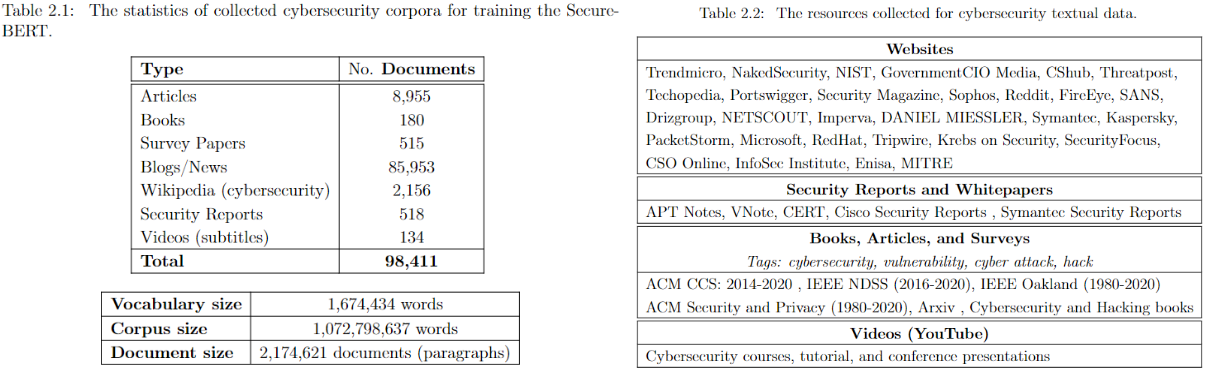
[SecureBERT](https://link.springer.com/chapter/10.1007/978-3-031-25538-0_3) was trained on extensive in-domain data crawled from diverse online resources. It has demonstrated strong performance in a range of cybersecurity NLP tasks.
👉 See the [presentation on YouTube](https://www.youtube.com/watch?v=G8WzvThGG8c&t=8s).
👉 Explore details on the [GitHub repository](https://github.com/ehsanaghaei/SecureBERT/blob/main/README.md).
---
## Applications
SecureBERT can be used as a base model for downstream NLP tasks in cybersecurity, including:
- Text classification
- Named Entity Recognition (NER)
- Sequence-to-sequence tasks
- Question answering
### Key Results
- Outperforms baseline models such as **RoBERTa (base/large)**, **SciBERT**, and **SecBERT** in masked language modeling tasks within the cybersecurity domain.
- Maintains strong performance in **general English language understanding**, ensuring broad usability beyond domain-specific tasks.
---
## Using SecureBERT
The model is available on [Hugging Face](https://huggingface.co/ehsanaghaei/SecureBERT).
### Load the Model
```python
from transformers import RobertaTokenizer, RobertaModel
import torch
tokenizer = RobertaTokenizer.from_pretrained("ehsanaghaei/SecureBERT")
model = RobertaModel.from_pretrained("ehsanaghaei/SecureBERT")
inputs = tokenizer("This is SecureBERT!", return_tensors="pt")
outputs = model(**inputs)
last_hidden_states = outputs.last_hidden_state
Masked Language Modeling Example
SecureBERT is trained with Masked Language Modeling (MLM). Use the following example to predict masked tokens:
#!pip install transformers torch tokenizers
import torch
import transformers
from transformers import RobertaTokenizerFast
tokenizer = RobertaTokenizerFast.from_pretrained("ehsanaghaei/SecureBERT")
model = transformers.RobertaForMaskedLM.from_pretrained("ehsanaghaei/SecureBERT")
def predict_mask(sent, tokenizer, model, topk=10, print_results=True):
token_ids = tokenizer.encode(sent, return_tensors='pt')
masked_pos = (token_ids.squeeze() == tokenizer.mask_token_id).nonzero().tolist()
words = []
with torch.no_grad():
output = model(token_ids)
for pos in masked_pos:
logits = output.logits[0, pos]
top_tokens = torch.topk(logits, k=topk).indices
predictions = [tokenizer.decode(i).strip().replace(" ", "") for i in top_tokens]
words.append(predictions)
if print_results:
print(f"Mask Predictions: {predictions}")
return words
```
# Limitations & Risks
* Domain-Specific Bias: SecureBERT is trained primarily on cybersecurity-related text. It may underperform on tasks outside this domain compared to general-purpose models.
* Data Quality: The training data was collected from online sources. As such, it may contain inaccuracies, outdated terminology, or biased representations of cybersecurity threats and behaviors.
* Potential Misuse: While the model is intended for defensive cybersecurity research, it could potentially be misused to generate malicious text (e.g., obfuscating malware descriptions or aiding adversarial tactics).
* Not a Substitute for Expertise: Predictions made by the model should not be considered authoritative. Cybersecurity professionals must validate results before applying them in critical systems or operational contexts.
* Evolving Threat Landscape: Cyber threats evolve rapidly, and the model may become outdated without continuous retraining on fresh data.
* Users should apply SecureBERT responsibly, keeping in mind its limitations and the need for human oversight in all security-critical applications.
# Reference
```
@inproceedings{aghaei2023securebert,
title={SecureBERT: A Domain-Specific Language Model for Cybersecurity},
author={Aghaei, Ehsan and Niu, Xi and Shadid, Waseem and Al-Shaer, Ehab},
booktitle={Security and Privacy in Communication Networks:
18th EAI International Conference, SecureComm 2022, Virtual Event, October 2022, Proceedings},
pages={39--56},
year={2023},
organization={Springer}
}
``` |